Jim Hightower’s Radio Lowdown

Beware: Billionaire Technocrats Say They Want to “Save” Humanity
We’re being told that an earth-shaking, transformative age of “generative artificial intelligence” is already upon us.
We’re told not to worry though, just accept it, because an elite clique of über-smart, über-rich tech barons have our backs. These Big Thinking Visionaries, we’re told, are already devising plans to shape humanity’s new future.
But wait – who’s telling us all this? Why the barons themselves! Yes, the same self-enriching Silicon Valley hucksters who have unleashed this invasive digital force on our world, now say they are planning to “save humanity.” How? By remaking our economy, laws, social systems, etc. to fit their new AI structure World Order.
Excuse me, but have any of those barons asked if you want to go there? I’ve not been consulted by them, have you? When did We The People elect such egomaniacal, anti-social, profiteering billionaires as Musk, Bezos, Zuckerberg, Altman, and Huang to decide humanity’s future? If you want to see their idea of a technocratic social order, visit one of Bezos’ hellish Amazon warehouses that has made him so royally rich. Or ask locals how Elon rampages autocratically over their communities, resources, homes, and rights.
No need to imagine what autocracy they might impose over us – just note that the trillion-dollar tech empires they already run routinely assert corporate property rights over all human rights, and how their lobbyists routinely rush to outlaw any public interference with the rapid spread of AI’s economic, environmental, and social greed.
These billionaire geniuses don’t want to save us from AI dominance, they’re trying to stampede us into their “kakistocracy.” What’s that? Government by the very worst people in society.
Do something!
To keep fighting Big Tech, check out the Athena Coalition, an organization of dozens of local and national groups who are “coming together to create an economy where everyone can thrive, safeguard our planet, and protect our democracy.” We can get with that! athenaforall.org
Jim Hightower's Lowdown is a reader-supported publication. To receive new posts and support my work, consider becoming a free or paid subscriber.
This is a public episode. If you'd like to discuss this with other subscribers or get access to bonus episodes, visit jimhightower.substack.com/subscribe
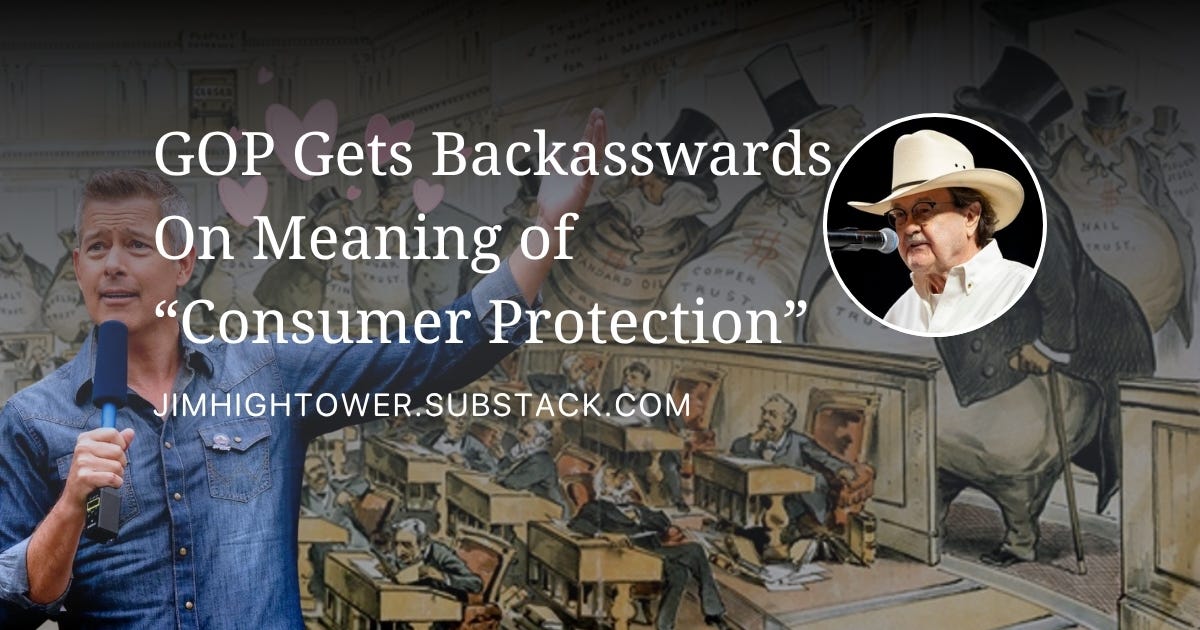
GOP Gets Backasswards On Meaning of “Consumer Protection”
You probably won’t believe this, boys and girls, but there was a time when government regulatory officials believed it was their public duty to – get this – serve the public!
How? By enforcing laws intended to protect consumers, workers, the environment and other targets of raw corporate greed. Today, though, far-right plutocrats behind Trump’s Project 2025 have turned our national protection agencies into private escort services for corporate predators.
Consider the monopolistic airline giants that have made price gouging and passenger abuse their normal business practice. It got so bad the Transportation Department finally mandated a handful of minimal reforms a few years ago. How minimal? The rules included such basic stuff as requiring airlines to tell customers the actual price of their ticket up front – no hidden fees. And requiring airlines to compensate customers if corporate mismanagement causes their flight to be disrupted. Also, making airlines liable for damages they do to wheelchairs of disabled passengers.
Any honest business would already be doing such things as a matter of personal integrity, but Sean Duffy has now screeches that corporate integrity is none of the public’s business. Who is Duffy? A run-of-the-mill laissez-faire extremist, former Republican Congressman, MTV reality show personality – and former Washington lobbyist for a firm representing the Big Three Airlines!
He’s now ensconced as Transportation Secretary in Trump’s cabinet, where he is pushing a sweeping agenda to repeal consumer protections. His agenda reads like a wish list put forth by the airline executives he had lobbied for. If this seems like profiteering corporate elites are making public rules to serve their own selfishness… Bingo! To keep tabs on their corporate thievery, go to TheRevolvingDoorProject.org.
Jim Hightower's Lowdown is a reader-supported publication. To receive new posts and support my work, consider becoming a free or paid subscriber.
This is a public episode. If you'd like to discuss this with other subscribers or get access to bonus episodes, visit jimhightower.substack.com/subscribe

Do You Suspect the System Is Rigged? Here’s Proof
Years ago, a Texas lawmaker got caught using his official position to enrich himself by taking money from special interests, in exchange for voting their way. The culprit did not deem this as corrupt, but just the normal ethic of an enterprising business transaction: “I seen my chances,” he explained, “and I took ‘em.”
This is the Clarence Thomas code-of-ethics. As has been widely reported, this Supreme Court judge (who reliably rules for corporate supremacy over the people’s interests) has secretly been on the take for years from a billionaire corporate right-winger. Real estate tycoon Harlan Crow, an extremist activist for plutocratic government, has been lavishing millions of dollars’ worth of luxury vacations, private jet travel, family housing and educational payments, and other gratuities on Thomas.
Yet, this supposedly-supreme lawyer says he detected no whiff of bribery, nor did he see any need to inform us commoners of it. He simply seen his chances and took ’em.
But Thomas knew damn well that it was improper, corrupting, and disgusting. After all, during the last three decades, he has consistently voted for court rulings to make such obvious graft legal. For example, he has voted again and again to drain common sense from our anti-corruption laws, declaring that it is legal for a corporation to keep a public official on private retainer, that it’s okay for political officials to sell access to their offices, that the “appearance of corruption” is not corrupt – and, directly relevant to Harlan Crow, Thomas voted that it is technically not bribery to try influencing public officials by bestowing a series of gifts to them over time.
If it seems to you like the system is rigged to favor the powerful, there you have it. Thomas is both the rigger and the beneficiary of the system.
Jim Hightower's Lowdown is a reader-supported publication. To receive new posts and support my work, consider becoming a free or paid subscriber.
This is a public episode. If you'd like to discuss this with other subscribers or get access to bonus episodes, visit jimhightower.substack.com/subscribe
Looking for older commentaries?
You’ll find them over on the Hightower Lowdown now, in the radio archives. Note: we post new episodes there on Tuesdays and Thursdays; however, some radio stations around the country air Hightower’s commentaries on their own schedule.
Stay in the loop with Hightower
Join Hightower’s email list:
Media Distribution Center
Hightower Affiliates, click here!
Not an Affiliate? Want to broadcast or print our commentaries? Apply here for your station or publication to become one today!
Meet Jim Hightower.
Looking for photos and more of Hightower? Check out the media kit.
National radio commentator, writer, public speaker, and New York Times best-selling author, Jim Hightower has spent five decades battling the Powers That Be on behalf of the Powers That Ought To Be – consumers, working families, environmentalists, small businesses, and just-plain-folks.
Twice elected Texas Agriculture Commissioner, Hightower believes that the true political spectrum is not right to left but top to bottom, and he has become a leading national voice for the 80 percent of the public who no longer find themselves within shouting distance of the Washington and Wall Street powers at the top.
Hightower is a modern-day Johnny Appleseed, spreading the message of progressive populism all across the American grassroots.
Hightower’s radio commentaries are carried on stations throughout the country, with a majority being carried on community radio stations in rural areas, where a democratic populist voice is craved and needed. He also writes two rousing weekly syndicated columns and publishes much of his work on Substack, blasting through the corporate media blockade to deliver an economic populist perspective to events.
He is a New York Times best-selling author, and has written seven books including, Thieves In High Places: They’ve Stolen Our Country And It’s Time To Take It Back; If the Gods Had Meant Us To Vote They Would Have Given Us Candidates; and There’s Nothing In the Middle Of the Road But Yellow Stripes and Dead Armadillos. His newspaper column is distributed nationally by Creators Syndicate.
Hightower frequently appears on television and radio programs, bringing a hard-hitting populist viewpoint that rarely gets into the mass media. In addition, he works closely with the alternative media, and in all of his work he keeps his ever-ready Texas humor up front, practicing the credo of an old Yugoslavian proverb: “You can fight the gods and still have fun.”
Hightower was raised in Denison, Texas, in a family of small business people, tenant farmers, and working folks. A graduate of the University of North Texas, he worked in Washington as legislative aide to Sen. Ralph Yarborough of Texas; he then co-founded the Agribusiness Accountability Project, a public interest project that focused on corporate power in the food economy; and he was national coordinator of the 1976 “Fred Harris for President” campaign. Hightower then returned to his home state, where he became editor of the feisty biweekly, The Texas Observer. He served as director of the Texas Consumer Association before running for statewide office and being elected to two terms as Texas Agriculture Commissioner (1983-1991).
During the 90’s, Hightower became known as “America’s most popular populist,” developing his radio commentaries, hosting two radio talk shows, writing books, launching his newsletter, giving fiery speeches coast to coast, and otherwise speaking out for the American majority that’s being locked out economically and politically by the elites.
As political columnist Molly Ivins said, “If Will Rogers and Mother Jones had a baby, Jim Hightower would be that rambunctious child — mad as hell, with a sense of humor.”
Books
 The New York Times bestselling author and America’s funniest activist gives the lowdown on how to put up-not shut up-in the fight for our future.
Hightower, the country’s #1 populist, has picked up some useful advice over the years, from “never eat at a café featuring ‘bargain kebobs'” to “never hit a man with glasses; hit him with something much heavier.” As he and his longtime co-conspirator Susan DeMarco have rambled through grassroots America, however, they’ve also come up with more serious words of wisdom to share here, namely: question authority, trust your values, seek alternatives, break away, stand up for your beliefs, and swim against the current!
Their book introduces readers to people across the country who have actually done this-people in business, politics, health care, farming, religion, and other areas who are taking charge, living their values, doing good, and doing well. Hightower and DeMarco show how they are doing precisely what the elites want us to believe can’t be done: changing their lives and making a difference. He tells the stories of these people and offers inspiration and information that will help readers tap into their own maverick potential in order to navigate a different, more satisfying course of their own.
Whether they are young and just starting out or older and searching for a different path, the commonsense folks in this book have escaped the corporate tentacles to find their own way toward a richer life and a better American future. They are creating a new, deeply democratic model for the country, edging it back onto the long road toward egalitarianism and the common good.
Hightower and DeMarco are at their contrarian, sharp-witted, and straight-shooting best as they celebrate the triumph of grassroots gumption over the tight-fisted grip of corporate control.
- Buy from Indiebound — support independent booksellers
- Buy from Powells.com — independent, too!
- Digital versions:
Android, Apple and Kindle - Audiobook on Audible.com
 America is at an historic divide between rulers and rulees and the rulees are restless. Hightower’s THIEVES IN HIGH PLACES is an epistle to the American people about vision and choices, and it’s a clarion call to action. The question Jim Hightower is asking is: What kind of country do you want America to be? Not only for you, but for your children and theirs? In THIEVES IN HIGH PLACES Hightower takes on the Bushites, the Wobblycrats, and the corporate Kleptocrats, digging up behind-the scenes dirt that the corporate media overlooks like BushCo’s “Friday Night Massacres”, what’s happened to our food, and the Bush plan for empire. Also drawing on Hightower’s Rolling Thunder Down-Home Democracy Tour, Hightower has tapped into the thriving activist networks that are our country’s grassroots muscle, and his book tells their uplifting stories of retaking control of their communities.
- Buy from Indiebound — support independent booksellers
- Buy from Powells.com — independent, too!
- Digital versions: Android,
AppleandKindle - Audiobook on Audible.com (combined with Let’s Stop Beating Around the Bush)
 The bestselling grassroots guru is back with his incisive take on the state of the union and life today in the good ol’ U.S.A.
America in 2004 is color coded and it’s not just a matter of red, white, and blue. The terror alert bounces from yellow to orange. The economy offers up a hundred shades of red ink. The environment is turning brown. National security is cloaked in gray shadows. And, as he did in the bestselling Thieves in High Places, Jim Hightower covers it all with uncommon insight, political fearlessness, and laugh-out-loud humor.
America’s #1 populist gives us Let’s Stop Beating Around the Bush a hard-hitting, fact-filled review of the real state of the union that you won’t get from the establishment media. With his daily radio commentaries and award-winning monthly newsletter, no one has chronicled the madness of King George the W, the wimpiness of corporate Democrats, and the aggressive avarice of Wall Street with the thoroughness and tenacity of Hightower. Now he brings that investigative punch into this wild and woolly hook of fiery essays.
With his satirical “Six Perfectly Good Reasons to Re-elect George W. Bush”; his mix of damning indictments and uplifting stories; and side bars, cartoons, games, and puzzles, Hightower has clone the impossible: he has created a subversive read that makes politics fun again.
- Buy from Indiebound — support independent booksellers
- Buy from Powells.com — independent, too!
- Digital versions: Android, Apple and Kindle
- Audiobook on Audible.com (combined with Thieves in High Places)

With his aw-shucks charisma and no-nonsense attitude, he dishes out what’s wrong with the eroding integrity of our democracy: politicians for sale to the highest bidder, the economic boom of the 90s not trickling down to the regular folks and more corporate scandals than you can shake a stick at. Offers a compelling collection of Hightower talks plus the best of his daily “Common-Sense Commentaries” on radio, all with an introduction by the late Senator Paul Wellstone.
 Jim Hightower, America’s favorite subversive, is still mad as hell, and he’s not going to take it anymore. But he will give you a sizeable piece of his mind on Election 2000. This plain-talking, name-naming, podium-pounding populist zeros in on everything that ails us, from the global economy and media to big business and election winners everywhere. In his hard hitting commentary and hilarious anecdotes, Hightower spares no one, including the scared cows — and especially the politicians — who helped steer us into this mess in the first place. An equal opportunity muckrucker and a conscientious agitator for “We the People”, Hightower inspires us to take charge again, build a new politics for a better tommorow — and have a lot of laughs along the way.
- Buy from Indiebound — support independent booksellers
- Buy from Powells.com — independent, too!
- Digital versions: Android, Apple and Kindle
Audiobook on Audible.com
 Revised, and with a New Introduction by the Author
“I am an agitator, and an agitator is the center post in a washing machine that gets the dirt out.”
–Jim Hightower
Hightower is mad as hell and he’s not going to take it anymore! He’s also funny as hell, and in this book he focuses his sharp Texas wit, populist passion, and native smarts on America’s political, economic, scientific, and media establishments. In There’s Nothing in the Middle of the Road But Yellow Stripes and Dead Armadillos, Hightower shows not only what’s wrong, but also how to fix it, offering specific solutions and calling for a new political movement of working families and the poor to “take America back from the bankers and bosses, the big shots and bastards.”
“If you don’t read another book about what’s wrong with this country for the rest of your life, read this one. I think it’s the best and most important book about out public life I’ve read in years.”
–Molly Ivins, author of Molly Ivins Can’t Say That, Can She?“When do we get to vote for Jim Hightower for president? Will somebody please tell me? When do we get to vote for Jim Hightower for president?.”
–Michael Moore, author of Downsize This!“Listen to Jim Hightower. His is a two-fisted, rambunctious voice unafraid to speak truth to power, eloquently and clearly…He’s one of the best.”
–Studs Terkel
- Buy from Indiebound — support independent booksellers
- Buy from Powells.com — independent, too!
- Digital versions: Android, Apple and Kindle
Audiobook on Audible.com